
1 / 3
Nasal Septal Button
A silicone button for non-surgical closure of nasal septal perforations, available in nine shapes and sizes.
Product Description
The Nasal Septal Button closes a symptomatic septal perforation without surgery. Made of flexible medical-grade silicone, it is placed through the perforation in an office procedure, with no incisions, and seats with a flange on each side of the septum.
By covering the perforation, the button can help reduce crusting, nosebleeds and the whistling sound that often comes with breathing through a perforated septum. It also helps protect the mucosa around the edges of the perforation.
Shapes and sizes
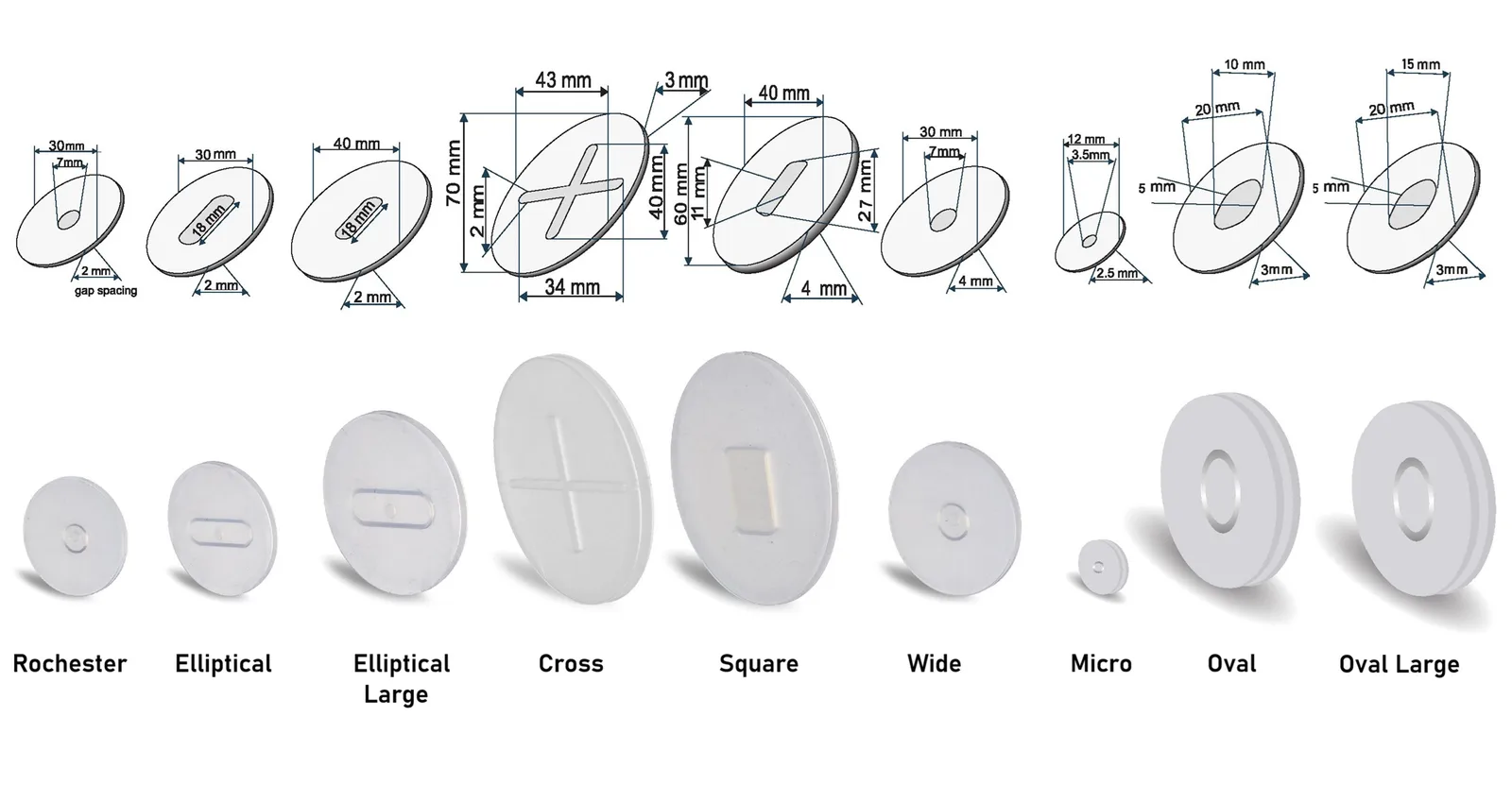
Perforations vary in size and shape, so the button comes in nine options, including circular, elliptical, square, cross and micro designs for irregular or non-circular perforations.
| Shape | Flange (mm) | Post (mm) | Gap (mm) | Part Number |
|---|---|---|---|---|
| Rochester | 30 × 30 | 7 round | 2 | EN77100000-RS |
| Elliptical | 30 × 30 | 18 × 5 elliptical | 2 | 2001-0101-ER |
| Elliptical Large | 40 × 40 | 18 × 5 elliptical | 2 | 2001-0102-EL |
| Cross | 70 × 43 | 40 × 40 cross | 3 | CC |
| Square | 60 × 40 | 27 × 11 | 4 | CS |
| Wide | 30 × 30 | 7 round | 4 | CW |
| Micro | 12 × 12 | 3.5 round | 2.5 | CM |
| Oval | 25 × 20 | 10 × 5 oval | 3 | CO |
| Oval Large | 20 × 20 | 15 × 5 oval | 3 | COB |
Sizing
The physician measures the perforation’s longest dimension, using a template or a radiographic technique, and selects a button that overlaps the edges by about 5 mm on all sides.
Correct sizing keeps the button in place. A button that is too small may migrate or dislodge, and one that is too large can obstruct the nasal valve.